What Maduro’s U.S. Capture Could Mean for Guyana and How It Could Fuel Instability If Mishandled
What We Know (Confirmed Reporting) On January 3, 2026, the United States carried out military strikes in Venezuela and announced it had captured Venezuelan President Nicolás Maduro. That announcement came from U.S. President Donald Trump, and has been widely reported by major outlets.
Venezuela’s government condemned the operation as “military aggression,” reported attacks in multiple areas (including Caracas), and said a national emergency had been declared. International reaction has been sharp. The UN Secretary-General warned the action could set a “dangerous precedent,” raising concerns about escalation and international law. Separately, the operation has already had regional spillover effects, such as major flight disruptions across parts of the Caribbean due to airspace restrictions and security concerns.
Why Guyana is Immediately Affected
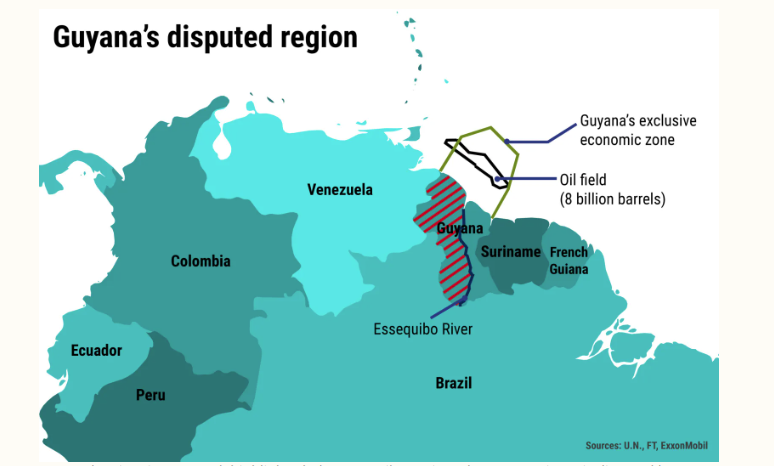
Guyana is not “watching from far away.” It shares a border with Venezuela and is locked in a high-stakes territorial dispute over the Essequibo region, administered by Guyana but claimed by Venezuela. That dispute is currently before the International Court of Justice (ICJ). In December 2023, the ICJ ordered Venezuela to refrain from taking actions that would modify the situation in the disputed territory while the case is pending. International Court of Justice
On the day of the U.S. action, Guyana’s government signaled heightened concern. President Irfaan Ali activated national security measures and met with Guyana’s defense leadership; the Guyana Defence Force said it remains vigilant and prepared to safeguard territorial integrity. Also important: Guyana has already experienced security incidents near the Venezuela border in the recent past, including an armed attack along the Cuyuni River that injured Guyanese soldiers, which Guyana linked to suspected Venezuelan gang elements (an allegation Venezuela denied).
1) Border pressure and miscalculation risk
When a large neighbor is in shock, leadership disruption, internal power struggle, or competing security forces—border regions can become less predictable. In Guyana’s case, the disputed zone is already sensitive, and the Cuyuni-area incident shows how quickly violence can occur near the frontier. AP News If rhetoric spikes or armed actors act without tight control, even a “small” confrontation can become a political flashpoint—especially with the Essequibo dispute in the background.
2) The Essequibo controversy becomes harder to manage in a crisis atmosphere
Guyana’s best protection has been rule-based diplomacy and legal process. If the region becomes more polarized or chaotic, it becomes harder to keep the spotlight on legal restraint and de-escalation. CARICOM states have publicly expressed serious concern and have moved to coordinate discussions, reflecting anxiety about spillover into neighboring countries. If regional governments split into rival camps—some endorsing the action, others condemning it—Guyana could face a harder diplomatic environment just when it most needs unified regional backing for calm and law-based dispute resolution.
3) Movement of people and humanitarian stress
Venezuela has produced one of the world’s largest displacement crises in recent years. UNHCR puts Venezuelan refugees and migrants globally at nearly 7.9 million. If Venezuela’s internal situation worsens, border countries can face sudden movement of people, raising practical pressures on border communities, services, and security screening. Guyana’s hinterland and border regions would be where those strains show first.
4) Regional economic and security uncertainty
Any escalation that affects shipping, air travel, or regional security perceptions can quickly raise costs and anxiety across the Caribbean and the Guianas, even for countries not directly involved. Reuters reported that in the lead-up to the operation, the U.S. imposed an oil- tanker blockade and seizures that sharply disrupted Venezuela’s exports and shipping patterns. Even if Guyana’s economy is on a different trajectory, sudden instability in a nearby oil-producing state can affect regional costs, maritime risk perceptions, and investor confidence.
How instability grows “if not handled properly”
- A power vacuum triggers armed competition inside Venezuela. If competing factions claim authority, security forces can fragment and violence can spread raising the risk of cross-border incidents and unpredictable decisions near neighbors. Concerns about escalation and “dangerous precedent” have already been raised at the UN after the U.S. action..
- Border areas become harder to control.When the state is distracted or divided, remote border zones often see more “freelance” armed activity (banditry, illegal mining, smuggling). Guyana has already faced shootings/injuries tied to armed men firing from the Venezuelan side in recent years, showing how quickly border security can deteriorate even without full-scale war..
- Refugee and migrant flows can surge suddenly.Venezuela is already one of the largest displacement situations in the world (UNHCR says nearly 7.9 million Venezuelan refugees and migrants globally). If conditions worsen, nearby states can face rapid inflows that strain services and border management..
- Economic shockwaves hit transport, trade, and energy risk perception. During major security crises, insurers, shippers, and airlines often change routing and pricing. The current situation has already caused wider regional disruptions and heightened uncertainty reported by major outlets..
My Professional Opinion
I don’t see this as a moment for Guyana to “pick a side” in a great-power showdown. Guyana’s strength is that it has stayed anchored to law, sovereignty, and measured diplomacy, especially through the ICJ route on Essequibo. In a volatile situation, the best way to prevent instability is to stay calm, stay united at home, and avoid letting fear, rumors, or political point-scoring drag us into a conflict that isn’t ours while still taking security seriously at the border.
Sources:
Ali, I., Banco, E., Holland, S., & Stewart, P. (2026, January 3). Mock house, CIA source and Special Forces: The US operation to capture Maduro. Reuters. https://www.reuters.com/business/aerospace-defense/mock-house-cia-source-special-forces-us-operation-capture-maduro-2026-01-03/
Hals, T., & Goudsward, A. (2026, January 3). Was the US capture of Venezuela’s president legal? Reuters. https://www.reuters.com/world/us/was-us-capture-venezuelas- president-legal-2026-01-03/
News Room Guyana. (2026, January 3). President Ali activates full national security system following U.S. military action in Venezuela. News Room Guyana. https://newsroom.gy/2026/01/03/president-ali-activates-full-national-security-system-following-u-s-military-action-in-venezuela/
Reuters. (2026, January 3). Trump says Venezuela’s Maduro captured after strikes. Reuters. https://www.reuters.com/world/americas/loud-noises-heard-venezuela-capital- southern-area-without-electricity-2026-01-03/
Reuters. (2026, January 3). UN Security Council to meet Monday over US action in Venezuela. Reuters. https://www.reuters.com/world/americas/un-chief-venezuela-us- action-sets-dangerous-precedent-2026-01-03/
The Associated Press. (2025, February 18). Guyana says 6 soldiers injured in a suspected gang attack on the Venezuela border. AP News. https://apnews.com/article/887cf9bde2dafc6b9a8ba7e42ed1bd33