GRA’s cease-and-desist to a Corriverton “backtrack” operator raises an old question: Informal Tradition vs. Formal Border Law
A cease-and-desist notice issued by the Guyana Revenue Authority (GRA) to a Corriverton-based speedboat operator has brought renewed attention to “backtracking” the long-running, informal boat movement of people (and often baggage and goods) between Guyana and Suriname. According to the letter, the GRA suspended services at Golden Gloves Back Track Service and said the operator was instructed to halt operations, with the agency stating the landing location being used is not recognised among the Authority’s approved ports of entry or approved “sufferance wharves.”
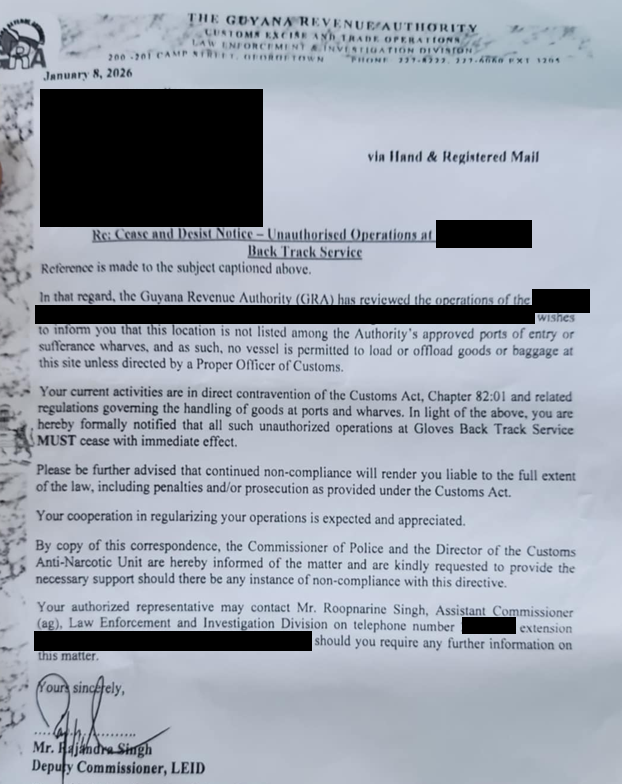
What the notice says: Based on the letter shown in the image, the GRA’s core position is straightforward: the business is operating from a location that is not authorised for loading/offloading, and therefore activity there must stop unless properly regularised. News Room reported that GRA warned of penalties and possible prosecution for continued non-compliance.
Why this may be happening now: enforcement pressure is rising at the Guyana–Suriname crossing
While “backtracking” has existed for decades, official attention to border compliance and smuggling risk has been increasing especially on the Corentyne. A recent Guyana Times report described the Guyana–Suriname border as increasingly porous, with business owners in Region Six warning that informal crossings, contraband supplies, and enforcement challenges are undermining legitimate commerce. The same report cited official ferry statistics showing legal cross-border movement is substantial and rising (e.g., passenger and vehicle totals in 2023–2024), while also describing concerns that significant movement still happens outside formal channels.
Historically, authorities have acknowledged the persistence of these crossings. A 2008 Stabroek News report discussed deadly incidents linked to the “backtrack” speedboat trade and quoted official remarks at the time suggesting enforcement was complicated and sensitive, even while urging travellers to use legal crossings. None of this proves why a specific operators were targeted now but it does establish a fact-based backdrop: higher volumes, sharper scrutiny, and recurring concerns about safety, smuggling, and oversight along the route.
What the law says: customs and immigration rules don’t treat “backtracking” as a special category.
Two legal frameworks matter most here: customs control over goods and wharves, and immigration control over entry/exit.
Under Guyana’s Customs Act, an “approved place of unloading/loading” is a quay/jetty/wharf (or similar place) specifically appointed by the Comptroller by notice in the Gazette. The Act also defines a “sufferance wharf” as a place (other than an approved place) where the Comptroller may allow goods to be loaded/unloaded under conditions he directs. Separately, the Customs Act includes specific powers aimed at small craft: an officer may detain a master and seek forfeiture if goods are found on a small ship and cannot be satisfactorily accounted for, where customs-law violations are suspected. It also contemplates regulations and licensing for ships under a certain size.
Guyana’s Immigration Act states that no person shall enter Guyana by sea or air except at a port of entry, and that persons arriving by sea/air should not disembark without consent of an immigration officer. The Act also creates offences for entering by sea/air other than at a port of entry, and for disembarking without consent (among other violations), with stated penalties on summary conviction. Importantly, the Immigration Regulations list specific “ports of entry,” including Springlands and other locations. In 2025, the Ministry of Home Affairs publicly reminded travellers that immigration laws are enforced under the Immigration Act and listed designated ports of entry/exit (including Moleson Creek, New Amsterdam, and Springlands in Region 6), warning that failure to comply would bring strict enforcement measures.
If regularisation is the issue, what would “regular” look like?
One pathway implied by the GRA’s position is that an operator would need to use an approved location or apply to have a location recognised as a sufferance wharf (or otherwise operate under customs direction). The GRA has published criteria for sufferance-wharf applications, including: written application, an approved plan of the premises, approvals/no-objections from relevant agencies (including MARAD, Lands & Surveys, EPA, and local authorities), fire approval, proof of ownership/occupancy, business registration, and security/bonding arrangements.
This matters because it reframes the dispute from “ending backtracking” to “forcing it into a regulated channel”, at least from the agency’s standpoint.
According to Section 2 of the Customs Act Chapter 82:01, “sufferance wharf means any place other than an approved place of loading or unloading at which the Commissioner-General may, in his discretion, and under such conditions and in such manner as he may direct, either generally or in any particular case, allow any goods to be loaded or unloaded.”
The main arguments on each side (Both sides of the coin)
The enforcement case (why authorities act)
- Border control and revenue: Customs law is built around controlling where goods can enter and ensuring duties, taxes, and inspections apply. Informal crossings can undermine that framework, as Region Six businesses have complained publicly about contraband and uneven enforcement.
- Security and screening: Immigration rules generally require entry and exit via ports of entry and interaction with immigration officers, and official messaging has emphasized compliance and enforcement.
- Legal clarity: The Customs Act’s language on approved loading/unloading sites and the procedures for sufferance wharves gives agencies a clear legal basis to say: “Not here, not like this.”
The community/business case (why people defend “backtracking”)
- It’s entrenched and functional: The practice has persisted for decades, and reporting over the years shows it continued even after public safety incidents and official concern.
- Demand, convenience, and livelihoods: On the Corentyne, cross-border family ties, shopping, work, and small trade create daily demand. When formal options feel slow, limited, or costly, informal services can fill a market gap (even when illegal under current rules).
- Fairness and transition: Critics of sudden crackdowns often argue that if the state tolerated a system for years, enforcement should come with a realistic transition: clear rules, accessible licensing, and consistent application across operators.
What to watch next
- Whether the operators applies to regularise (e.g., via a sufferance wharf process or relocation to an approved point).
- Whether enforcement expands beyond a few operators, especially if officials link it to broader anti-smuggling or immigration compliance pushes.
- Whether policymakers address the “gap” that keeps informal crossings alive: travel demand, border-processing capacity, and local economic dependency.
A neutral bottom line
The GRA notice is not just about a few businessmen, it highlights a long-standing contradiction: a widely used border practice sitting beside a legal framework that prioritizes controlled entry points, documented loading/unloading, and enforceable oversight. If Guyana’s agencies are now tightening the net, the most durable outcome won’t come from a few small shutdowns; it will come from whether the state can pair enforcement with a credible, workable route for legal cross-border movement that communities will actually use.
Sources & Documents
News Room. (2026, January 10). GRA orders Golden Gloves Back Track Service to suspend operations and regularise service. News Room Guyana.
Read the sourceCarmichael, A. (2026, January 4). Porous Guyana-Suriname border places Region 6 businesses under mounting pressure. Guyana Times.
Read the sourceStabroek News. (2008, October 28). Suriname backtrack boats too ‘technical’ to be dealt with now – Greene. Stabroek News.
Read the sourceMinistry of Home Affairs (Guyana). (2025, February 9). Press statement: Mandatory immigration procedures at ports of entry and exit. Ministry of Home Affairs.
Read the sourceMinistry of Legal Affairs (Guyana). (n.d.). Immigration Act, Chapter 14:02 (including Immigration Regulations) [PDF]. Ministry of Legal Affairs.
Read the source (PDF)Government of Guyana. (1998). Customs Act, Chapter 82:01 (L.R.O. 3/1998) [PDF]. Organization of American States (OAS).
Read the source (PDF)Guyana Revenue Authority. (2022, June 14). Notice – Notification of requirements for sufferance wharf. Guyana Revenue Authority.
Read the source