Essequibo and the Guyana–Venezuela Border Dispute: A Working Timeline (Origins to Present Day)
The Guyana–Venezuela border controversy is often discussed in headlines, but it is best understood as a sequence of documents, deadlines, and decisions that stretch back more than a century. Below is a working timeline you can use for reference, followed by why these dates matter now, while the case remains before the International Court of Justice (ICJ).
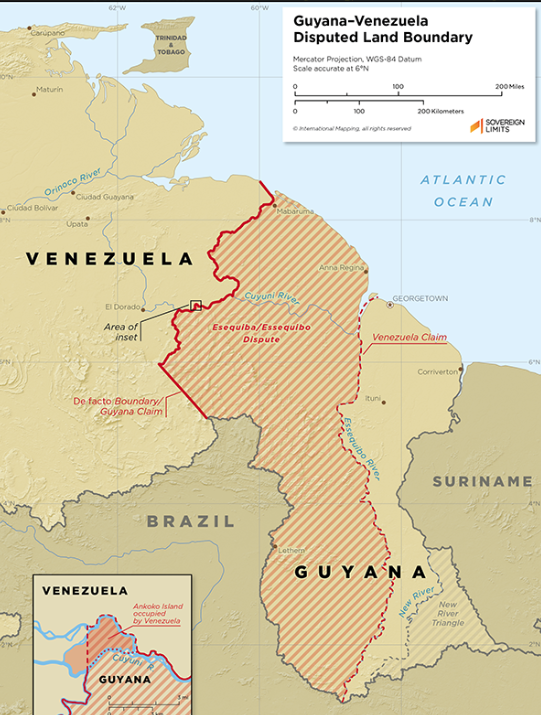
Quick orientation: Guyana administers the Essequibo region. Venezuela claims it. Guyana argues the boundary was settled by the 1899 Arbitral Award. Venezuela argues the award is invalid. The matter is now being argued at the ICJ.
Working Timeline (Key Milestones)
- 1814–1840 (early boundary formation): Britain formalizes control of what becomes British Guiana; surveys such as the Schomburgk work become key reference points in later boundary claims.
- 1895–1899 (escalation to arbitration): The dispute intensifies internationally and ends in arbitration.
- 3 October 1899 (Paris Arbitral Award): An arbitral tribunal issues the award determining the boundary between British Guiana and Venezuela.
- 1905 (demarcation period): Boundary demarcation work is carried out to give effect to the award.
- 1949 (Mallet-Prevost memo enters public debate): The memorandum becomes a key reference for Venezuela’s modern political argument about the award’s legitimacy.
- 1962 (United Nations attention): Venezuela raises the controversy at the UN, placing the matter back into international diplomacy.
- 17 February 1966 (Geneva Agreement): The Geneva Agreement establishes a peaceful settlement framework and the UN Secretary-General’s role if the parties cannot agree on a method.
- 1966 (post-independence tensions): The dispute remains active as Guyana becomes independent, with incidents and diplomatic strain around the frontier.
- 1970 (Port of Spain Protocol): The Protocol pauses/suspends parts of the settlement process for a defined period.
- 1990–2017 (UN “Good Offices”): The UN Secretary-General’s Good Offices process continues for decades without a final settlement.
- 30 January 2018 (ICJ chosen by the UN Secretary-General): After Good Offices ends, the UN Secretary-General selects judicial settlement at the ICJ as the method.
- March–April 2018 (Guyana files at the ICJ): Guyana institutes proceedings seeking confirmation of the legal validity of the 1899 award and the boundary.
- 18 December 2020 (ICJ jurisdiction decision): The Court rules it has jurisdiction to hear the case (within the scope set out by the Court).
- 1 December 2023 (ICJ provisional measures): The ICJ orders restraint to avoid actions that could alter the situation in the disputed territory while the case is pending.
- 14 December 2023 (Argyle Declaration): Guyana and Venezuela agree to avoid escalation and maintain dialogue even while disagreeing on the merits.
- 1 May 2025 (ICJ order related to elections/administrative steps): The Court reinforces interim guardrails while the matter remains unresolved.
- Present day: The ICJ case is ongoing. The legal process continues alongside political and security pressures in the region.
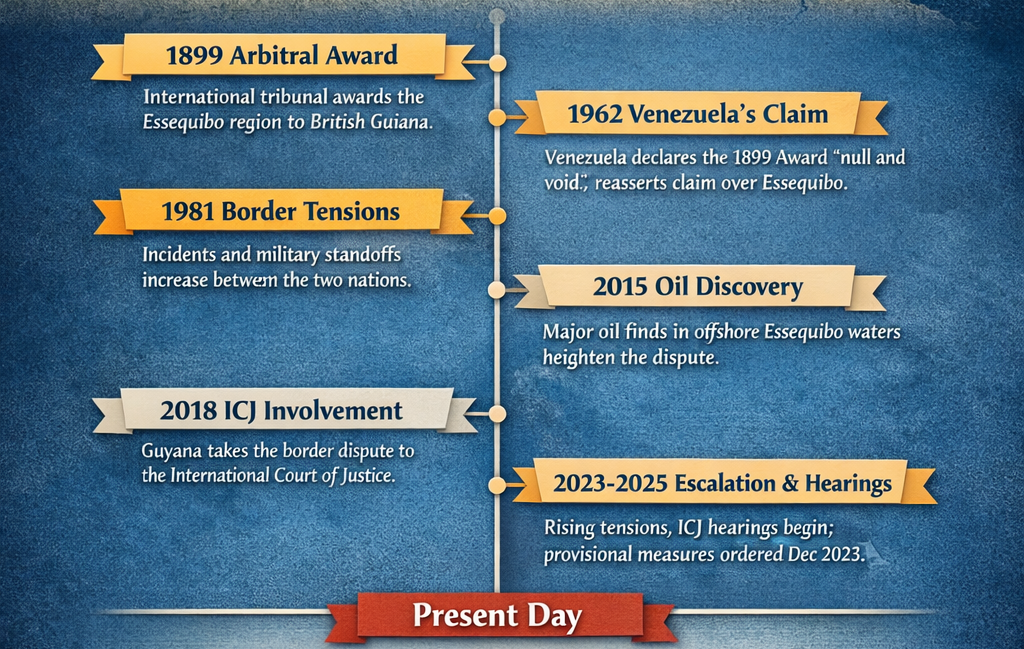
What is the ICJ is actually deciding?
At its core, the Court is being asked to determine the legal status of the 1899 Arbitral Award and the boundary that flows from it. The Court’s interim orders (provisional measures) are important because they are meant to prevent one side from changing conditions on the ground while judges consider the merits.
Why the timeline matters now more than ever.
Timelines are not just history, they are leverage. The Geneva Agreement created a pathway. The UN Good Offices period showed the limits of diplomacy alone. The move to the ICJ created a single legal forum for a final answer. Meanwhile, domestic politics can move faster than the law, which is why interim restraint matters: it reduces the risk that symbolism, elections, or administrative declarations turn into real-world incidents.
My Professional Opinion
Guyana’s advantage has always been discipline: staying anchored to law, restraint, and diplomacy while building international understanding of the case. The most dangerous moments are when leaders try to score quick domestic wins that create irreversible facts on the ground. If both states keep the dispute inside the legal process, and keep public messaging calm the region buys time for a lawful, final resolution.
Sources & Documents
International Court of Justice. (n.d.). Arbitral Award of 3 October 1899 (Guyana v. Venezuela) (Case No. 171).
icj-cij.org — Open sourceInternational Court of Justice. (2018, March 29). Application instituting proceedings (Guyana v. Venezuela).
icj-cij.org — Open sourceInternational Court of Justice. (2020, December 18). Judgment: Jurisdiction of the Court (Guyana v. Venezuela) [PDF].
icj-cij.org — PDFInternational Court of Justice. (2023, December 1). Order: Provisional measures (Guyana v. Venezuela) [PDF].
icj-cij.org — PDFUnited Nations. (2018, January 30). Secretary-General chooses International Court of Justice as means for peacefully settling long-standing Guyana–Venezuela border controversy (Press release SG/SM/18879).
press.un.org — Open sourceUnited Nations. (1966). Agreement to resolve the controversy between Venezuela and the United Kingdom of Great Britain and Northern Ireland over the frontier between Venezuela and British Guiana (Geneva, 17 February 1966) [PDF].
treaties.un.org — PDFUnited Nations. (1971). Protocol to the Agreement to resolve the controversy… (“Protocol of Port of Spain”) (Port of Spain, 18 June 1970) [PDF].
treaties.un.org — PDFMinistry of Foreign Affairs and International Cooperation (Guyana). (2023, December 14). Joint Declaration of Argyle for Dialogue and Peace between Guyana and Venezuela [PDF].
minfor.gov.gy — PDF